Administrative Paralysis: Why High Performers Can't Complete Simple Tasks
7 min read
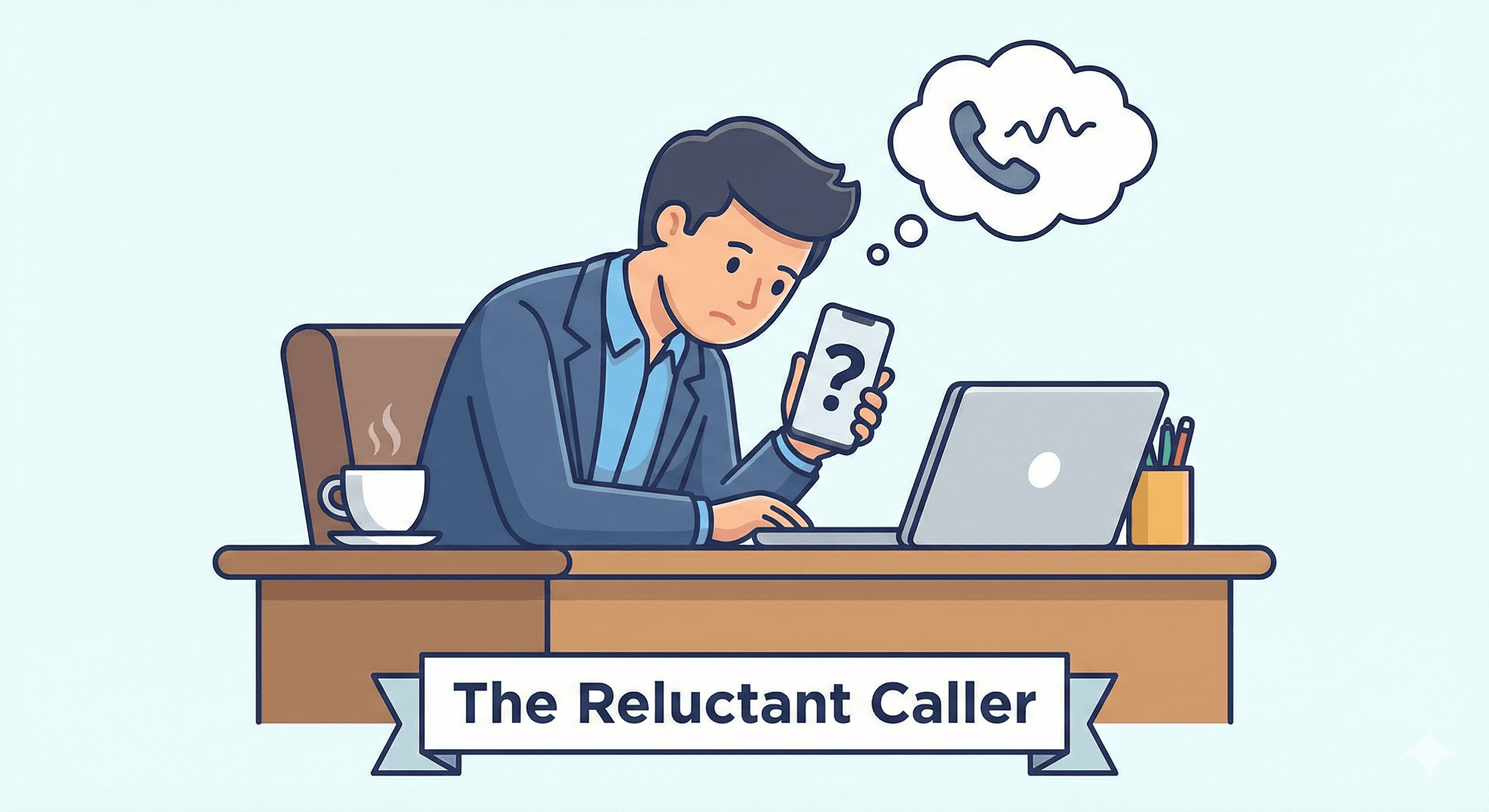
Last Tuesday, I watched a grown man—VP of Engineering at a Series B startup—admit in a group chat that he's been "forgetting" to schedule his colonoscopy for two years.
Two years.
This is a guy who manages 40 engineers, architects distributed systems handling millions of requests per second, closes seven-figure deals. He cannot pick up the phone and call a doctor's office.
The group chat exploded. Not with mockery. With relief.
"Bro I've had a cavity for 8 months."
"My car registration expired in March. It's November."
"I owe my landlord an email from literally 2022."
Seventeen people. Combined comp probably north of $3 million. All admitting they can't handle tasks a 1990s secretary would knock out before lunch.
They're not alone. According to a Harvard Business Review study, 73% of executives admit to avoiding simple administrative tasks for weeks or months at a time.
What the hell is wrong with us?
What is Administrative Paralysis?
Here's something nobody talks about at conferences or in LinkedIn posts:
The more successful you are at complex work, the worse you get at simple tasks.
It sounds backwards. If you can negotiate a $2M contract, surely you can call the dentist? If you can debug a production outage at 3 AM, surely you can email your property manager?
Nope.
Administrative paralysis is the inability to complete simple, low-stakes tasks despite knowing exactly what needs to be done and having the ability to do it.
Research from Princeton University found that cognitive load doesn't just reduce your capacity for hard tasks—it obliterates your ability to do easy ones. When your brain is full, the mundane stuff falls through first. The urgent and complex gets handled because it has to. The simple and flexible gets punted. Forever.
This creates a brutal paradox: the better you are at your job, the more your personal admin falls apart.
Ready to stop avoiding admin tasks? See how Index92 handles them for you →
Quick Self-Assessment: Do You Have Administrative Paralysis?
Answer honestly:
- Is there a doctor/dentist appointment you've been "meaning to book" for more than 30 days?
- Do you have an email draft sitting unsent because you couldn't figure out the right tone?
- Have you ever paid a late fee on something you had the money for—just because you didn't open the bill?
- Is there a phone call on your mental to-do list that you think about at least twice a week but never make?
- Do you sometimes fantasize about having an assistant just to handle the boring stuff?
If you said yes to three or more: welcome to the club. Membership is free and the only perk is shared suffering.
Why Your Brain Hates Admin Tasks (The Science Behind Task Avoidance)
Skip this section if you don't care about the why. But the why is actually interesting, I promise.
Your brain runs on predictions.
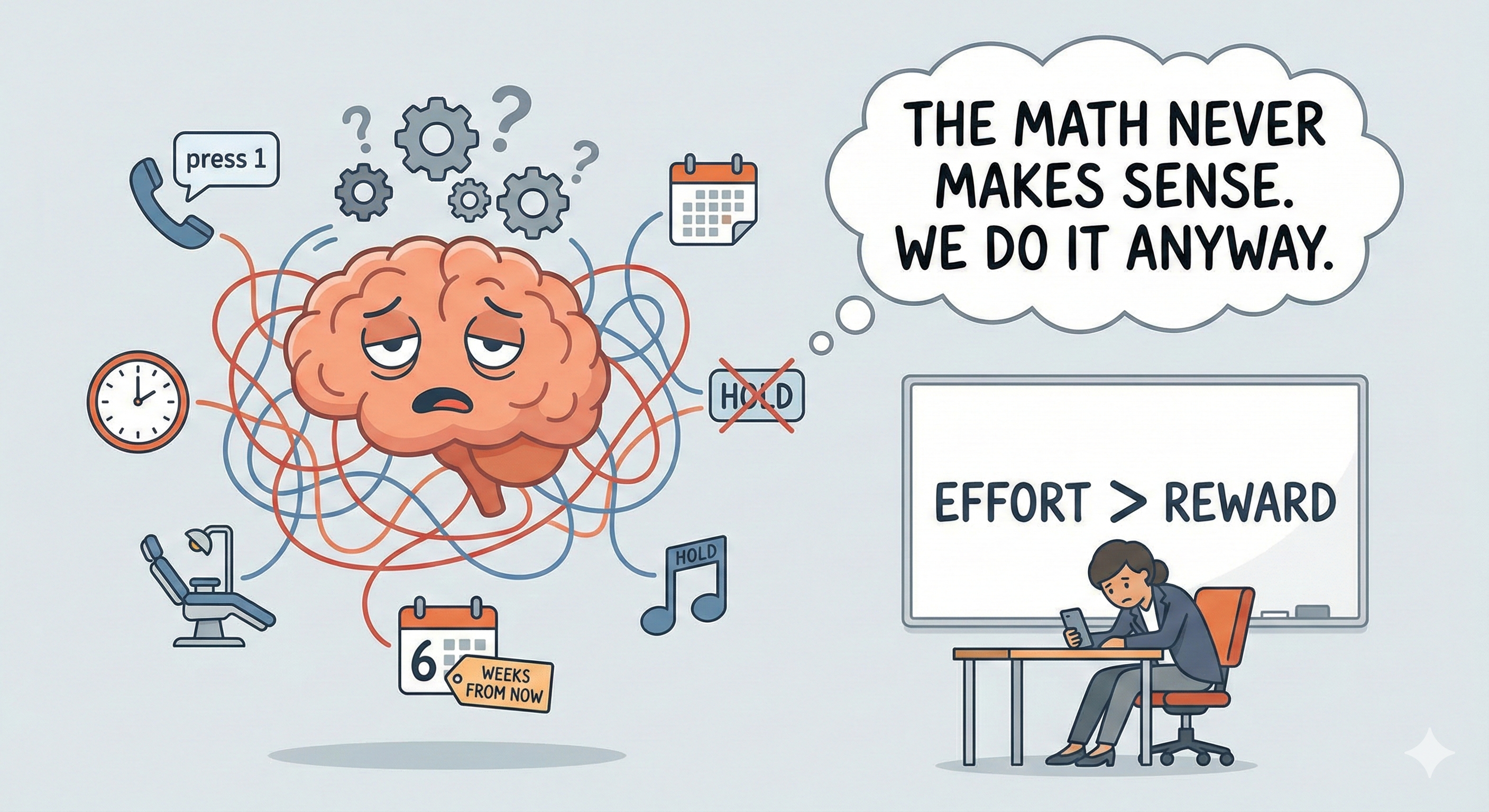
According to neuroscience research published in Nature, every action you take, your brain simulates the outcome first. It's running thousands of micro-predictions per second, calculating reward vs. effort.
When you think about calling the dentist, here's what your brain simulates:
- Find the phone number (effort)
- Dial, wait for answer (effort + uncertainty)
- Navigate the "press 1 for..." maze (effort + frustration)
- Wait on hold (effort + time loss + hold music trauma)
- Explain what you need (effort + social energy)
- Coordinate calendars (effort + decision-making)
- Confirm details (effort)
- Hang up (finally)
Reward: An appointment 6 weeks from now for something that might not even be a problem.
Your brain does this math in milliseconds and returns: NOT WORTH IT. TRY AGAIN TOMORROW.
Tomorrow, same math. Same result.
This isn't laziness. This isn't a character flaw. It's your prediction engine being brutally rational about immediate costs vs. distant rewards. Psychologist Piers Steel calls this Temporal Motivation Theory—we're hardwired to discount future rewards and overweight immediate effort.
Who Gets Hit Hardest by Administrative Paralysis?
High-performers with demanding jobs. The more cognitively demanding your work, the less bandwidth you have for low-priority tasks.
People with ADHD. The executive function challenges make task initiation particularly difficult. It's not about capability; it's about neurological hurdles between knowing and doing.
Caregivers and parents. When you're responsible for other humans, your own administrative tasks get pushed to the bottom. Repeatedly.
Anyone going through transitions. New job, new city, new relationship—life transitions multiply administrative tasks while simultaneously reducing your capacity to handle them.
The Real Cost of Task Avoidance (Your Brain Won't Calculate This)
Your brain is bad at long-term math. Let me do it for you.
That dentist appointment you've been avoiding for 6 months:
- Cavity that could've been a $150 filling is now a $1,200 root canal
- 6 months of low-grade "I should really..." mental drain
- The actual call when you finally make it: 4 minutes
That landlord email about the leak:
- Water damage that turns a $200 repair into a $3,000 problem
- Potential security deposit loss
- Documented communication trail you now don't have
- Time to write the email: 7 minutes
That insurance dispute you gave up on:
- $847 you were owed and never got
- Time to make the call: 22 minutes including hold
You're not saving time by avoiding these tasks. You're borrowing time at 1000% interest.
Solutions That Don't Work for Administrative Paralysis
I'm not writing this from a place of superiority. I'm writing it because I've been the guy with the expired registration and the unsent emails and the medical thing I was definitely going to "deal with next week."
Here's what I tried:
The "Eat the Frog" method: Do your worst task first thing in the morning. Result: I just started my mornings with dread and still didn't make the calls.
Time blocking: Schedule specific admin hours. Result: When the block arrived, I'd look at it, feel tired, and move it to tomorrow.
Accountability buddy: Tell someone you'll do it. Result: Now I was avoiding the task AND avoiding my friend's follow-up texts.
The 2-minute rule: If it takes less than 2 minutes, do it now. Result: My brain learned to estimate everything at 3 minutes.
Outsourcing to my partner: "Hey can you just call the..." Result: Now we're both annoyed and the task still isn't done.
Nothing worked. Not because the methods are bad, but because they all still required ME to do the thing. And I was the problem.
The Only Solution That Actually Works: Total Responsibility Transfer
I'm about to say something that sounds obvious but isn't:
The only way to guarantee a task gets done is to remove yourself from the task.
Not "remind yourself better." Not "motivate yourself more." Not "schedule it smarter."
Remove. Yourself. Entirely.
This is why wealthy people don't have administrative paralysis. They have other humans doing their admin. The dentist gets booked because someone else books it. The landlord gets emailed because someone else emails them. The insurance gets disputed because someone on payroll disputes it.
The task isn't on their mental to-do list because it's not their task.
For the rest of us, that's never been an option. Hiring a personal assistant costs $3-5K/month. That's not in the budget when you're making $127K/year and living in a city where that barely covers rent.
So we just... suffer. We accumulate the tasks. We feel the guilt. We pay the late fees and the upgrade-to-root-canal costs and the "sorry I never got back to you" relationship erosion.
Until now.
What If the Task Just... Happened?
Imagine this.
You wake up tomorrow. You think, "I really need to book that dentist appointment."
Then you remember: it's already booked. Tuesday at 2pm. You got a confirmation last week. It's in your calendar.
You didn't make the call. You didn't navigate the phone tree. You didn't coordinate your schedule while on hold. You just... said you needed a dentist appointment, and now you have one.
The landlord email about the leak? Sent three days ago. Professional, firm, documented. There's already a reply—maintenance is coming Thursday.
The insurance dispute? Resolved. $847 back on your card. You have a recording of the call and a confirmation number.
This isn't a fantasy about being rich enough for a staff. This is what Index92 actually does.
You tell it what needs to happen. It makes the calls. Sends the emails. Handles the follow-ups. Books the appointments. Provides proof everything's done.
Not suggestions. Not drafts. Not reminders.
Completion. With receipts.
The Uncomfortable Truth About Task Avoidance
You're never going to "get better" at admin tasks.
I know that's not what productivity Twitter wants you to believe. They want you to think the right app, the right system, the right morning routine will transform you into someone who cheerfully makes phone calls.
It won't.
Because the problem isn't your system. It's that these tasks are genuinely not worth your cognitive resources—and your brain knows it.
The solution isn't to fight your brain harder. It's to stop making your brain do work it was never designed to enjoy.
Some tasks need your genius. Making a dentist appointment isn't one of them.
Stop Letting Simple Tasks Run Your Life
Limited spots. We onboard 10-15 new users per week to ensure quality.
"The ultimate luxury is the absence of noise."